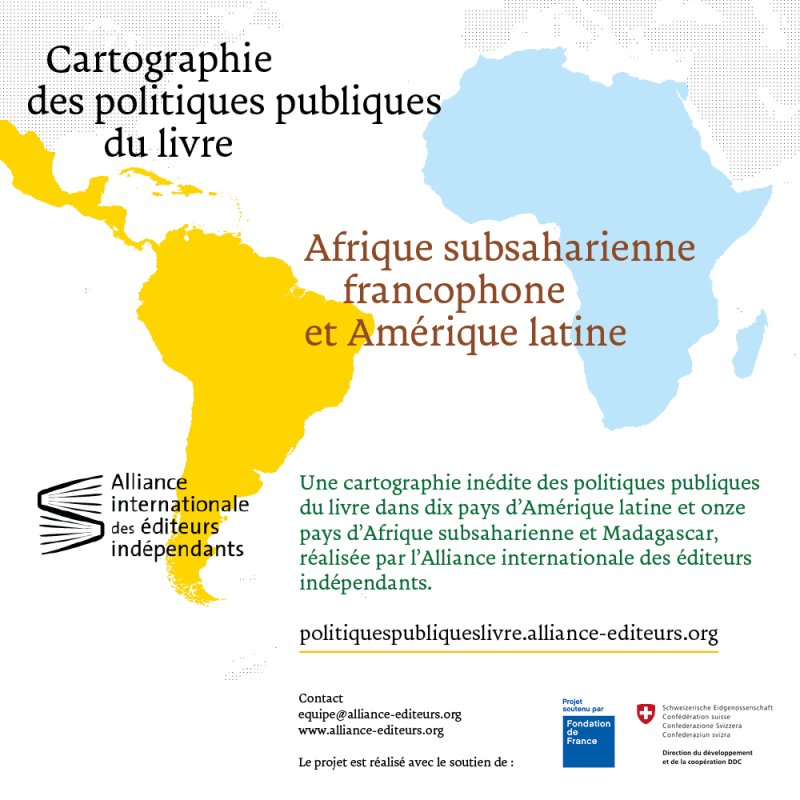
Public book policies are a set of measures, standards, frameworks and laws that structure and support the book field in a given country : they must strengthen a given country’s book sector, help to support local production, the dissemination and access of all to the book, in particular through the implementation of adequate regulatory and tax measures and the multiplication of reading spaces (public libraries for example). Public book policies need to be developed and implemented with all book professionnals, in each country. It is also necessary for these national policies to be extended by regional and international policies.
Analysis of data collected in 10 countries from independent publishers and public actors, by Andrés E. Fernández Vergara (University of Chile)
This article, written in Spanish, offers a regional analysis of public policies for the development of books and reading in Spanish-speaking Latin America, from the point of view of 53 actors in the book world from 10 different countries. It takes into account the similarities and differences that exist from one country to another in the region : on the one hand, there are complex networks of institutions and book promotion mechanisms ; on the other hand, there is no national policy or strategic objective. The actors interviewed highlight the difficulties they encounter in their sector today : market concentration, piracy, lack of support for indigenous languages, etc. These are all dangers that threaten bibliodiversity in the region.
Contents :
Methodology
Censorship and content control
Laws, public policies and regulatory mechanisms for books and reading
Institutions and organisations working in the fields of books and reading
Direct support and assistance for books and reading
Data collection in the 11 countries of sub-Saharan Africa and Madagascar as well as in Latin America, cross-sectional data analyses and online mapping were supported by the Fondation de France and the SDC Switzerland.
Cross-sectional analysis of data collected in 12 countries, by Luc Pinhas, University of Paris 13 Villetaneuse (France)
In a comprehensive cross-sectional study that enriches our knowledge of public book policies in French-speaking sub-Saharan Africa, Luc Pinhas discusses the similarities and differences that exist between 12 countries in the region. While some very interesting developments for local book production and the local book chain should be acknowledged – cf. the preference given to local actors by the Ivorian law of 2015 – the legislative and regulatory frameworks would certainly benefit from being strengthened to support and strengthen the local book economy.
Data collection in the 11 countries of sub-Saharan Africa and Madagascar as well as in Latin America, cross-sectional data analyses and online mapping were supported by the Fondation de France and the SDC Switzerland.
Contact the Alliance team to get a free digital version of this issue dedicated to public book policies.
Publication : June 2019
The Bibliodiversité review is copublished by Double ponctuation and the International Alliance of independent publishers.
See other issues of Bibliodiversité review here : “Self-publishing” ; “Committed publishing”…
Overview of the issue :
From censorship to safeguarding, public initiatives in the book sector are varied.
This issue proposes academic articles, professional’ views and two previously unpublished regional analyses (sub-Saharan Africa and Spanish-speaking Latin America), taking us from Russia to Switzerland, via Syria, Lebanon, Tunisia, Morocco, Quebec, France and Argentina.
All contributions seek an answer to this question : does the intervention of public authorities support editorial diversity ?
Contents of the ‘Public book policies issue’ :
“Introduction : action taken by public authorities to support books”, by Étienne Galliand, Editor-in-Chief of Bibliodiversity Journal
“Federalism and cohesion – New book policies in Switzerland”, by Carine Corajoud, historian (Switzerland)
“A relative autonomy – A comparative analysis of the room for manoeuvre
in public publishing in France”, by Hélène Seiler-Juilleret, École des hautes études en sciences sociales (Higher School of Social Sciences, France)
“Negotiating control, promoting reading – Independent publishers and the Russian State in the 2010s”, by Bella Ostromooukhova, Paris Sorbonne University (France and Russia)
“Morocco : escheated books – The shortcomings in state involvement in the books and written word sector”, by Anouk Cohen, CNRS (France and Morocco) and Kenza Sefrioui, Ph.D. in comparative literature, literary critic and publisher (Morocco)
“Government policy on books in Tunisia” – A publisher’s view, by Nouri Abid, Med Ali publishers (Tunisia)
“Government policy on books in Syria” – A publisher’s view, by Samar Haddad, Atlas Publishing (Syria)
“Government policy on books in Lebanon” – A bookseller’s view, by Michel Choueiri, bookseller (France and the United Arab Emirates)
“Government policy on books in sub-Saharan Africa and Madagascar. A cross-sectional analysis of data collected in 12 countries”, by Luc Pinhas, University of Paris 13 Villetaneuse (France)
“Publishing and public authorities : the Quebec case – Or the influence of public action on editorial independence ?”, by Pascal Genêt, Sherbrooke University (Quebec-Canada)
“Laws, public policies, institutions and measures to support books and reading
in Latin America – An analysis of data gathered in 10 countries”, by Andrés E. Fernández Vergara (University of Chile)
“From culture towards business – An analysis of a state support programme
for local publishing in Buenos Aires : Opción Libros”, by José de Souza Muniz Jr., Federal Centre for Technological Education, Minas Gerais (Brazil)
Authors, publishers, booksellers, librarians and readers form what is commonly known as a “book ecosystem”, an expression that reflects the interdependence between actors in the book field. However, over the past few years, the discussions, both globally and in Europe, about re-defining the intellectual property rights, and the evolution of practices in the digital era, led to division that gradually distanced these stakeholders, with the risk of weakening the solidarity that unites them.
Fortunately, new conversations have started, more specifically about the cultural rights, opening a space where this topic can be debated and addressed from a new angle with focus on issues related to the balance of rights. Starting from the idea that fundamental rights are inseparable, it seems possible to understand author rights, cultural rights and social rights as a coherent whole. The challenge is to find an approach that would stop opposing the book professionals, to re-establish coalitions towards the conquest for new rights. Due to their specific position, independent publishers could play an important role in framing this collective discussion in the book sector.
Lionel Maurel
A Law Degree holder, Lionel Maurel is currently a librarian at the University Paris Lumières Library. Author of the S.I.Lex blog, he specialises in Intellectual Property, Digital Law, and Cultural Law. Involved in the Commons movement, he co-founded the collective SavoirsCom1 (“Common Knowledges”) and is a member of the Strategic Orientation College of La Quadrature du Net. Picture : thesupermath. CC-BY-SA. Source : Wikimedia Commons, remix by Guénaël Boutouillet
Read here the report of the workshop on « African Book Industry », organized by the Global Book Alliance (USAID) and the Association for the Development of Education in Africa (ADEA) in Abidjan (Ivory Coast) in January 2018.
The workshop brought together 79 key stakeholders in the African Book Publishing Industry from 22 African countries. More information here.
Publishing professionals charter and code of ethics, produced by the Organisation malienne des éditeurs de livre (OMEL), Mali, 2017.
This charter was produced by OMEL (Organisation malienne des éditeurs de livre) in April 2017, which authorized the Alliance to publish it on its website.
Re|Shaping Cultural Policies 2018 (UNESCO 2005 Convention Global Report)
Creativity at the Heart of Development
Excerpt from the foreword :
“This new UNESCO Global Report ‘Re|Shaping Cultural Policies’ is an invaluable tool for the implementation of the 2005 Convention on the Protection and Promotion of the Diversity of Cultural Expressions. This Convention, now ratified by 146 Parties, including the European Union, is leading UNESCO’s efforts to strengthen capacities for the creation, production, and dissemination of cultural goods, services, and activities. States are supported in their sovereign right to implement public policies for the development of strong and dynamic cultural and creative industry sectors. UNESCO is committed to developing more effective and sustainable public policies in these areas.
Our roadmap is clear and requires the cooperation of governments and non-governmental actors in four key areas : strengthening governance for culture, improving the conditions for the mobility of artists, integrating culture in sustainable development strategies, and promoting human rights and fundamental freedoms. These four goals are closely linked to the 2030 Agenda for Sustainable Development.”
Publishers from Algeria, Lebanon, Morocco and Tunisia presented a panorama of book public policies in their respective countries : Chilean and French publishers spoke on what is being implemented in their countries – a dialogue and exchange between professionals and public authorities, between continents, between cultures.
This day was initiated in the context of the Bibliodiversity Observatory and the mapping of public book policies in Latin America and the Arab world, on-going at the Observatory.
Following the publication in 2019 of a mapping of public book policies in French-speaking sub-Saharan Africa/ Madagascar and Latin America, the independent publishers of the Arab world are pleased to present the mapping of public book policies in 11 countries in the region : Egypt, Jordan, Kuwait, Lebanon, Morocco, Oman, Palestine, Sudan, Syria, Tunisia and Yemen.
Given the instability and socio-political fragility in the region, this project was a challenge that the project coordination team (Samar Haddad, Atlas Publishing in Syria ; Fayez Allam, Syria ; Hani Altelfah, Marfaa for Culture and Publishing in Turkey) met with determination and conviction.
(Re)experience in pictures the launch of the mapping of public policies in the Arab world, which took place at the Cité de la Culture in Tunis in June 2025.
Objectives and methodology
The mapping was developed between 2018 and 2019 for the following 2 regions : Latin America and Sub-Saharan Africa/ Madagascar. Work to update the data for these two regions has been underway since November 2025. The mapping was finalised in 2025 for the Arab world (the data collected dates from 2023-2024 for this region).
The mapping proposes a comparative approach to public book policies in three regions of the world –Latin America, sub-Saharan Africa/Madagascar and the Arab world– and emphasises the need for them to maintain bibliodiversity in the regions studied. These overviews provide an overall context, particularly through the cross-sectional analyses, as well as information on the specific measures being implemented in each country, through the country profiles. These two levels of information highlight both the similarities and the differences between the countries studied. One of the main aims of this tool is to encourage dialogue between publishing professionals and public authorities to consolidate and/or develop public policies in each country.
For the Arab world, data was collected from book professionals and public authorities in around twenty countries. In many cases, the data collected was not sufficiently accurate or complete : while the absence of and/or difficulty in obtaining information is a significant element of analysis in itself (on the lack of transparency of book support schemes, on the lack of knowledge among book professionals of existing legislative frameworks, on the absence of book-related policies, etc.), the information was too incomplete for these countries to be mapped. There are therefore gaps in this mapping : several countries representing very significant economic and cultural weight for books in the Arab world are not (yet) mapped. This mapping (undoubtedly) contains inaccuracies, even errors : several pieces of information received were contradictory and although they were checked, it was sometimes very difficult to arrive at certainties. We apologise for this in advance and would be grateful for any comments or remarks you may have. The mapping is not set in stone and is work in progress : you can contribute to it (click on “Contribute” when you are in a country file). If you would like to add a country to the map, please contact us : equipe@alliance-editeurs.org
Once the data had been collected, Hani Altelfah (a researcher and publisher based in Turkey) carried out a cross-cutting analysis of the data. This analysis focuses on several key issues, including freedom of expression, the various forms of censorship, the socio-economic environment of the book, intellectual property rights, etc. It is available here in Arabic and here in English.
Acknowledgements
The International Alliance of Independent Publishers warmly thanks all the book professionals who have contributed to this project ; Samar Haddad, who has tirelessly supported this project, despite all the challenges encountered and the many moments of doubt ! Fayez Allam, who worked behind the scenes with immense patience ; Hani Altelfah for his energy and the quality of his analyses ; Franck Mermier for his proofreading and advice ; the team of translators and proofreaders (Dahouk Rukieh, Abdulla Fadel, Anna Akkash) ; Dépli Studio for designing the mapping website ; Nouri Abid (Med Ali, Tunisia) for organising the mapping launch in Tunis.
Finally, the Alliance would like to thank the Open Society Foundations for their invaluable support and trust.
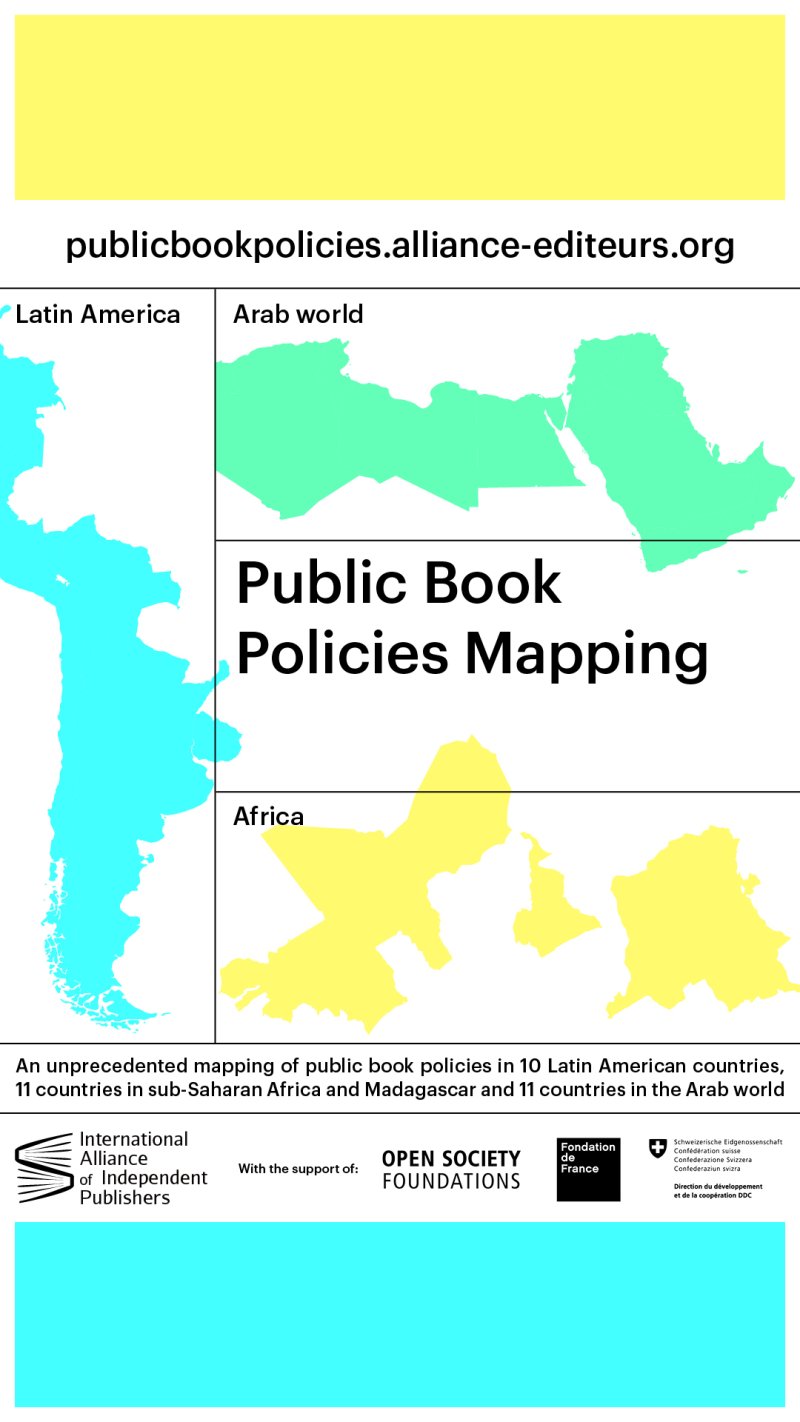
An unprecedented mapping of policies supporting reading and books in 22 countries, which can be consulted and downloaded online : publicbookpolicies.alliance-editeurs.org
The mapping proposes several items : one entry per country (country fact sheets listing existing mechanisms for public support for books at the national level) ; a regional entry (comparative data through cross-cutting analyses). It is interactive and evolving : the fact sheets presenting the institutions and national public book policies can be amended and modified as the systems evolve. This mapping is thus intended to be extended to new countries in both regions, or even to integrate a new region in the long term (the Arab world in particular). For now, the mapping exists only in Spanish and French for lack of financial means to carry out a translation into English. The Alliance hopes to find the necessary funds to translate the mapping into English soon.
The objectives of the mapping are to :
• make available data on the public book policies of the respective countries ;
• offer an overview of public book policies, freely accessible, consultable and reusable by professionals and public authorities ;
• promote dialogue and exchanges between public authorities and publishers ;
• develop advocacy tools for independent publishers ;
• contribute to the establishment and consolidation of public book policies in developing countries (among others, for a greater circulation of books and ideas, for the appropriation of digital tools by book professionals, for balanced exchanges between North and South) ;
• affirm the role of civil society (book professionals and particularly independent publishers) in the development and implementation of public book policies.