Public book policies are a set of measures, standards, frameworks and laws that structure and support the book field in a given country : they must strengthen a given country’s book sector, help to support local production, the dissemination and access of all to the book, in particular through the implementation of adequate regulatory and tax measures and the multiplication of reading spaces (public libraries for example). Public book policies need to be developed and implemented with all book professionnals, in each country. It is also necessary for these national policies to be extended by regional and international policies.
These 80 recommendations are built on the principles upheld in the 2014 International Declaration of independent publishers, an important document promoting bibliodiversity, signed on September 20th 2014, by more than 400 independent publishers from 45 countries.
They raise the necessary prerequisites, divided by themes, for the development, maintenance and strengthening of bibliodiversity in concerned countries. Some recommendations are accompanied by tools and projects (existing or to be developed in the context of the 2015-2016 Alliance programme of activities), enabling a practical implementation of independent publishers’ proposals.
Contents of the 80 recommendations & tools in support of bibliodiversity :
* Public policies safeguarding bibliodiversity
* Proposals and actions supporting digital bibliodiversity
* The Amazon system, a threat to bibliodiversity ?
* Essential measures for publishing in local and national languages
* Methods for rethinking book donations
* Proposals and actions to develop solidarity publishing partnerships
* Activities to strengthen diversity in youth publishing
For all book actors to take ownership of these recommendations and tools, we invite you to contact us with your comments, suggestions, ideas, and proposals that could enhance and strengthen this document.
“« Protect” the Book » by Markus GERLACH, a report from the collection “Reports on the Publishing World”, is now available in Italian from the Italian Federation of Independent Publishers (FIDARE), which translated and published this new edition.
This reference book has been translated into several languages (French, Spanish, Portuguese, Italian).
Year of publication : 2010, 68 pages, 15 X 21 cm, 8 euros.
Massively used by small publishing firms to distribute their products to bookstores, libraries, and readers, the postal service is the most popular means of circulating books throughout the world. However, the absence, suppression or questioning of special postage for books is an impediment to bibliodiversity in many countries.
In Latin America, with a huge territory to cover and limited circulation, a large share of publishers ensures the delivery of their products themselves. For these publishers, preferential postage rates for shipping books are all the more vital.
This study, available in Spanish, was carried out as an International Alliance of independent publishers exclusive by Elena Enríquez Fuentes (Mexico) in 2008.
Her work demonstrates that there is a considerable bias in the trading of books between Spain and Latin America. This assertion is based on the analysis of exports and imports between Spain and Latin America in 2006 and 2007.
As the official campaign for the next European elections is being launched, the Alliance has decided to get involved in a positive fashion by formulating three proposals that would be very simple to implement.
These proposals have furthermore been published on the website http://challengeforeurope.blogactiv.eu, with dozens of others, on the initiative of the Charles Léopold Mayer Foundation in the framework of its “What kind of Europe do we want ?” program. Let us hope this impressive corpus of proposals will be a profitable inspiration to the EU’s future elected representatives !
Why did the large majority of European countries choose to protect the book, setting its price through trade agreements or legal measures ? How were these protection mechanisms, which make the book into a cultural exception permitted by the European Commission, gradually implemented ? Markus Gerlach offers a broad analysis the price-fixing of books in Europe : he begins by relating the background of this measure and then analyzes the economic effects. In the end he shows the extent to which the price-fixing of books, apart from its cultural and economic importance, also assumes an eminently political dimension.
« Protéger le livre » by Markus Gerlach (in French) - available in Spanish (« Cómo proteger el libro »), in Portuguese (« Proteger o livro ») and in Italian (« Proteggere il libro »).
Year of publication : 2006, 160 pages, 15 x 21 cm, ISBN 10 : 2-9519747-2-8 ; ISBN 13 : 978-2-9519747-2-2
Why do books have such restricted circulation in the French-speaking world ? Which way does the flow go and which are one-way streets ? What current legislation encourages publishing and the marketing of works ? Are public policies sufficient ? What setbacks are encountered in the marketing of works ? Luc Pinhas draws a comprehensive portrait of the state of publishing, including legislation, circulation, distribution and marketing of books in the French-speaking world. This dossier, featuring entries on many themes and geographic locations, provides a complete overview of local realities, illustrated with telling examples. After analysing measures that states, associations and syndicates of publishing and book-store professionals have implemented, the author puts forward some proposals to fuel a much-needed debate. To achieve this and to hear what the main players had to say, especially with regard to the South, a fruitful survey was conducted at the Ouagadougou book fair in November 2004, in partnership with the international Association of French-speaking Bookstore Managers (AILF) - [http://www.librairesfrancophones.org/]
Year of publication : 2005, 288 pages, 15 X 21 cm, ISBN : 978-2-9519747-1-X
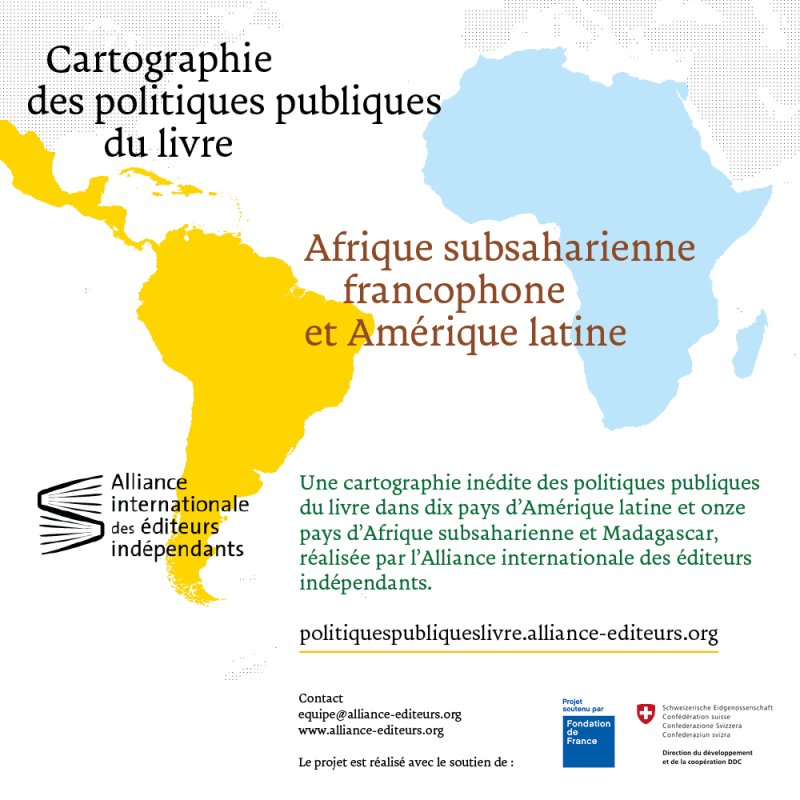
Following the publication in 2019 of a mapping of public book policies in French-speaking sub-Saharan Africa/ Madagascar and Latin America, the independent publishers of the Arab world are pleased to present the mapping of public book policies in 11 countries in the region : Egypt, Jordan, Kuwait, Lebanon, Morocco, Oman, Palestine, Sudan, Syria, Tunisia and Yemen.
Given the instability and socio-political fragility in the region, this project was a challenge that the project coordination team (Samar Haddad, Atlas Publishing in Syria ; Fayez Allam, Syria ; Hani Altelfah, Marfaa for Culture and Publishing in Turkey) met with determination and conviction.
(Re)experience in pictures the launch of the mapping of public policies in the Arab world, which took place at the Cité de la Culture in Tunis in June 2025.
Objectives and methodology
The mapping was developed between 2018 and 2019 for the following 2 regions : Latin America and Sub-Saharan Africa/ Madagascar. Work to update the data for these two regions has been underway since November 2025. The mapping was finalised in 2025 for the Arab world (the data collected dates from 2023-2024 for this region).
The mapping proposes a comparative approach to public book policies in three regions of the world –Latin America, sub-Saharan Africa/Madagascar and the Arab world– and emphasises the need for them to maintain bibliodiversity in the regions studied. These overviews provide an overall context, particularly through the cross-sectional analyses, as well as information on the specific measures being implemented in each country, through the country profiles. These two levels of information highlight both the similarities and the differences between the countries studied. One of the main aims of this tool is to encourage dialogue between publishing professionals and public authorities to consolidate and/or develop public policies in each country.
For the Arab world, data was collected from book professionals and public authorities in around twenty countries. In many cases, the data collected was not sufficiently accurate or complete : while the absence of and/or difficulty in obtaining information is a significant element of analysis in itself (on the lack of transparency of book support schemes, on the lack of knowledge among book professionals of existing legislative frameworks, on the absence of book-related policies, etc.), the information was too incomplete for these countries to be mapped. There are therefore gaps in this mapping : several countries representing very significant economic and cultural weight for books in the Arab world are not (yet) mapped. This mapping (undoubtedly) contains inaccuracies, even errors : several pieces of information received were contradictory and although they were checked, it was sometimes very difficult to arrive at certainties. We apologise for this in advance and would be grateful for any comments or remarks you may have. The mapping is not set in stone and is work in progress : you can contribute to it (click on “Contribute” when you are in a country file). If you would like to add a country to the map, please contact us : equipe@alliance-editeurs.org
Once the data had been collected, Hani Altelfah (a researcher and publisher based in Turkey) carried out a cross-cutting analysis of the data. This analysis focuses on several key issues, including freedom of expression, the various forms of censorship, the socio-economic environment of the book, intellectual property rights, etc. It is available here in Arabic and here in English.
Acknowledgements
The International Alliance of Independent Publishers warmly thanks all the book professionals who have contributed to this project ; Samar Haddad, who has tirelessly supported this project, despite all the challenges encountered and the many moments of doubt ! Fayez Allam, who worked behind the scenes with immense patience ; Hani Altelfah for his energy and the quality of his analyses ; Franck Mermier for his proofreading and advice ; the team of translators and proofreaders (Dahouk Rukieh, Abdulla Fadel, Anna Akkash) ; Dépli Studio for designing the mapping website ; Nouri Abid (Med Ali, Tunisia) for organising the mapping launch in Tunis.
Finally, the Alliance would like to thank the Open Society Foundations for their invaluable support and trust.
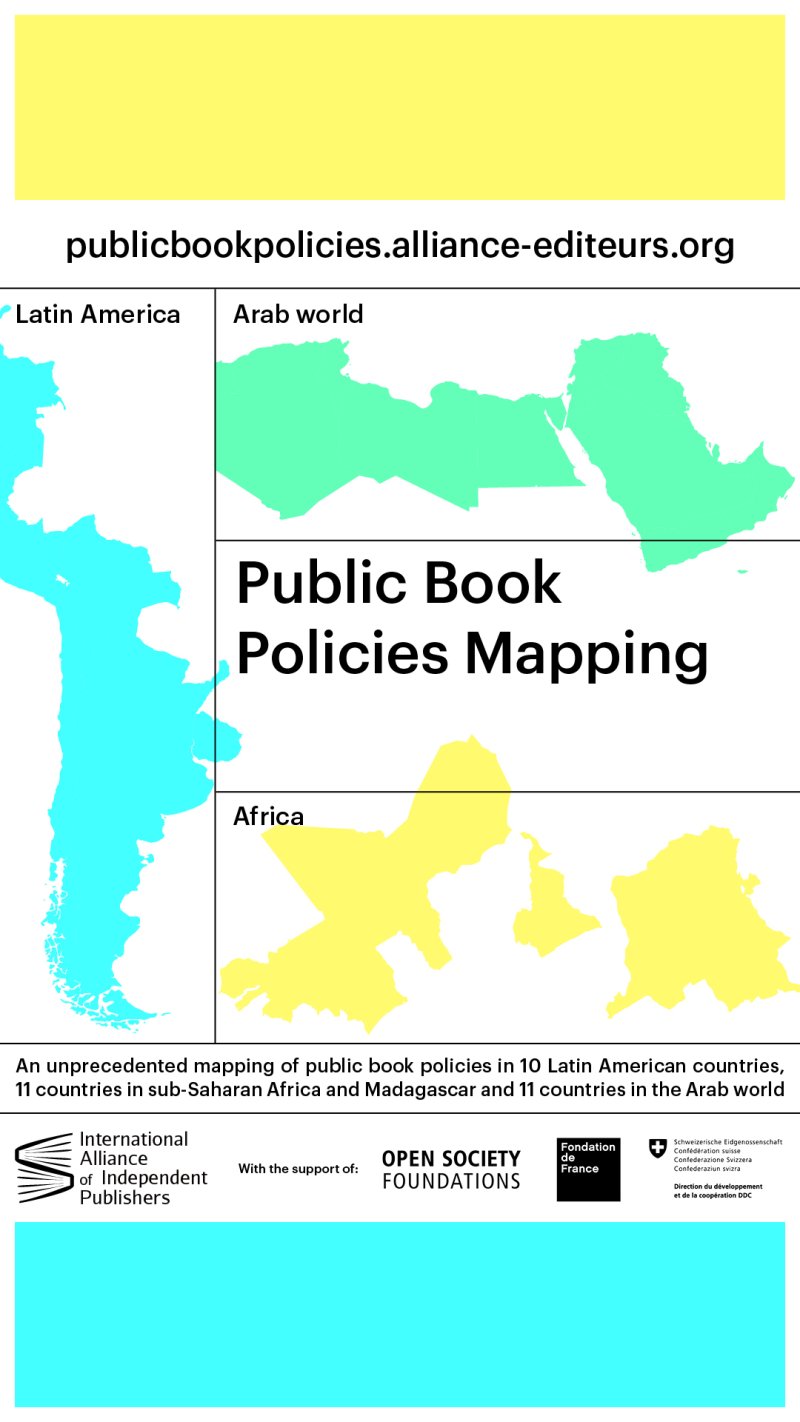
An unprecedented mapping of policies supporting reading and books in 22 countries, which can be consulted and downloaded online : publicbookpolicies.alliance-editeurs.org
The mapping proposes several items : one entry per country (country fact sheets listing existing mechanisms for public support for books at the national level) ; a regional entry (comparative data through cross-cutting analyses). It is interactive and evolving : the fact sheets presenting the institutions and national public book policies can be amended and modified as the systems evolve. This mapping is thus intended to be extended to new countries in both regions, or even to integrate a new region in the long term (the Arab world in particular). For now, the mapping exists only in Spanish and French for lack of financial means to carry out a translation into English. The Alliance hopes to find the necessary funds to translate the mapping into English soon.
The objectives of the mapping are to :
• make available data on the public book policies of the respective countries ;
• offer an overview of public book policies, freely accessible, consultable and reusable by professionals and public authorities ;
• promote dialogue and exchanges between public authorities and publishers ;
• develop advocacy tools for independent publishers ;
• contribute to the establishment and consolidation of public book policies in developing countries (among others, for a greater circulation of books and ideas, for the appropriation of digital tools by book professionals, for balanced exchanges between North and South) ;
• affirm the role of civil society (book professionals and particularly independent publishers) in the development and implementation of public book policies.