


Available in Arabic, English, French and Spanish.
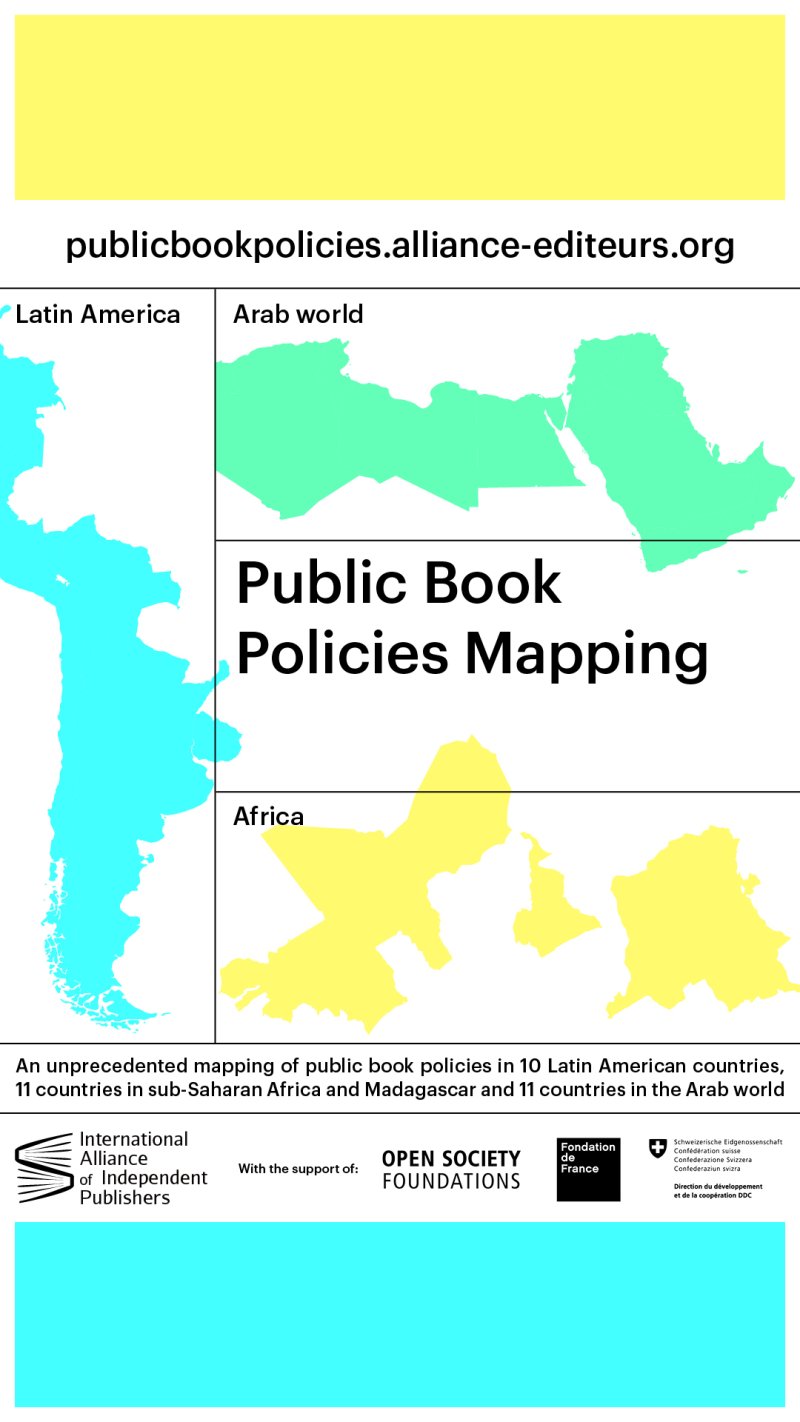
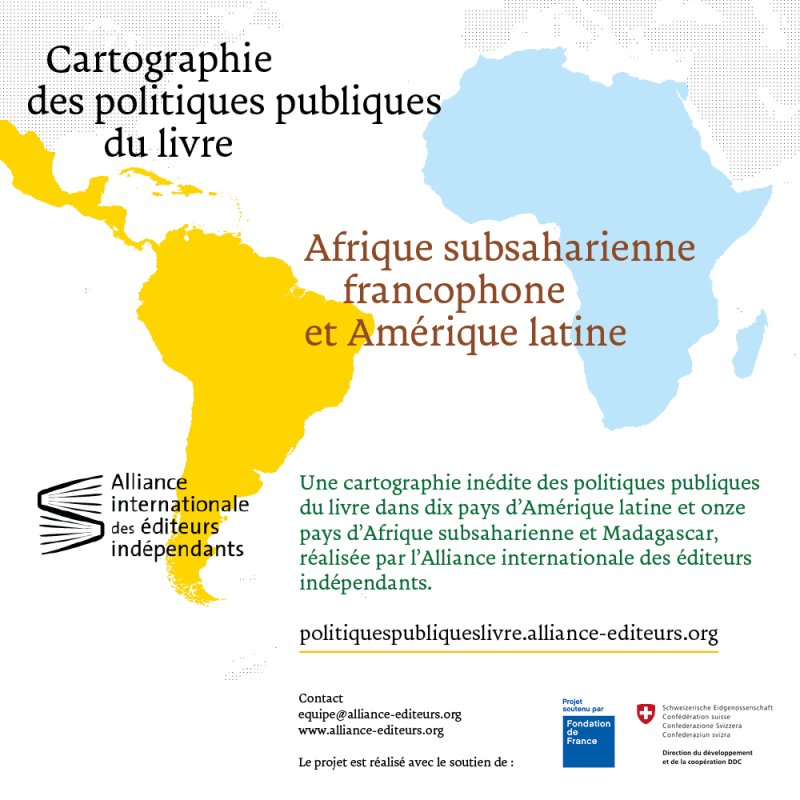
Following the publication in 2019 of a mapping of public book policies in French-speaking sub-Saharan Africa/ Madagascar and Latin America, the independent publishers of the Arab world are pleased to present the mapping of public book policies in 11 countries in the region : Egypt, Jordan, Kuwait, Lebanon, Morocco, Oman, Palestine, Sudan, Syria, Tunisia and Yemen.
Given the instability and socio-political fragility in the region, this project was a challenge that the project coordination team (Samar Haddad, Atlas Publishing in Syria ; Fayez Allam, Syria ; Hani Altelfah, Marfaa for Culture and Publishing in Turkey) met with determination and conviction.
(Re)experience in pictures the launch of the mapping of public policies in the Arab world, which took place at the Cité de la Culture in Tunis in June 2025.
Objectives and methodology
The mapping was developed between 2018 and 2019 for the following 2 regions : Latin America and Sub-Saharan Africa/ Madagascar. Work to update the data for these two regions has been underway since November 2025. The mapping was finalised in 2025 for the Arab world (the data collected dates from 2023-2024 for this region).
The mapping proposes a comparative approach to public book policies in three regions of the world –Latin America, sub-Saharan Africa/Madagascar and the Arab world– and emphasises the need for them to maintain bibliodiversity in the regions studied. These overviews provide an overall context, particularly through the cross-sectional analyses, as well as information on the specific measures being implemented in each country, through the country profiles. These two levels of information highlight both the similarities and the differences between the countries studied. One of the main aims of this tool is to encourage dialogue between publishing professionals and public authorities to consolidate and/or develop public policies in each country.
For the Arab world, data was collected from book professionals and public authorities in around twenty countries. In many cases, the data collected was not sufficiently accurate or complete : while the absence of and/or difficulty in obtaining information is a significant element of analysis in itself (on the lack of transparency of book support schemes, on the lack of knowledge among book professionals of existing legislative frameworks, on the absence of book-related policies, etc.), the information was too incomplete for these countries to be mapped. There are therefore gaps in this mapping : several countries representing very significant economic and cultural weight for books in the Arab world are not (yet) mapped. This mapping (undoubtedly) contains inaccuracies, even errors : several pieces of information received were contradictory and although they were checked, it was sometimes very difficult to arrive at certainties. We apologise for this in advance and would be grateful for any comments or remarks you may have. The mapping is not set in stone and is work in progress : you can contribute to it (click on “Contribute” when you are in a country file). If you would like to add a country to the map, please contact us : equipe@alliance-editeurs.org
Once the data had been collected, Hani Altelfah (a researcher and publisher based in Turkey) carried out a cross-cutting analysis of the data. This analysis focuses on several key issues, including freedom of expression, the various forms of censorship, the socio-economic environment of the book, intellectual property rights, etc. It is available here in Arabic and here in English.
More information on the methodology and the project here.
Acknowledgements
The International Alliance of Independent Publishers warmly thanks all the book professionals who have contributed to this project ; Samar Haddad, who has tirelessly supported this project, despite all the challenges encountered and the many moments of doubt ! Fayez Allam, who worked behind the scenes with immense patience ; Hani Altelfah for his energy and the quality of his analyses ; Franck Mermier for his proofreading and advice ; the team of translators and proofreaders (Dahouk Rukieh, Abdulla Fadel, Anna Akkash) ; Dépli Studio for designing the mapping website ; Nouri Abid (Med Ali, Tunisia) for organising the mapping launch in Tunis.
Finally, the Alliance would like to thank the Open Society Foundations for their invaluable support and trust.