28 Sin Ming Lane, 06-131
Singapore 573972
Singapour
Tél: +65 66591749
www.ethosbooks.com.sg
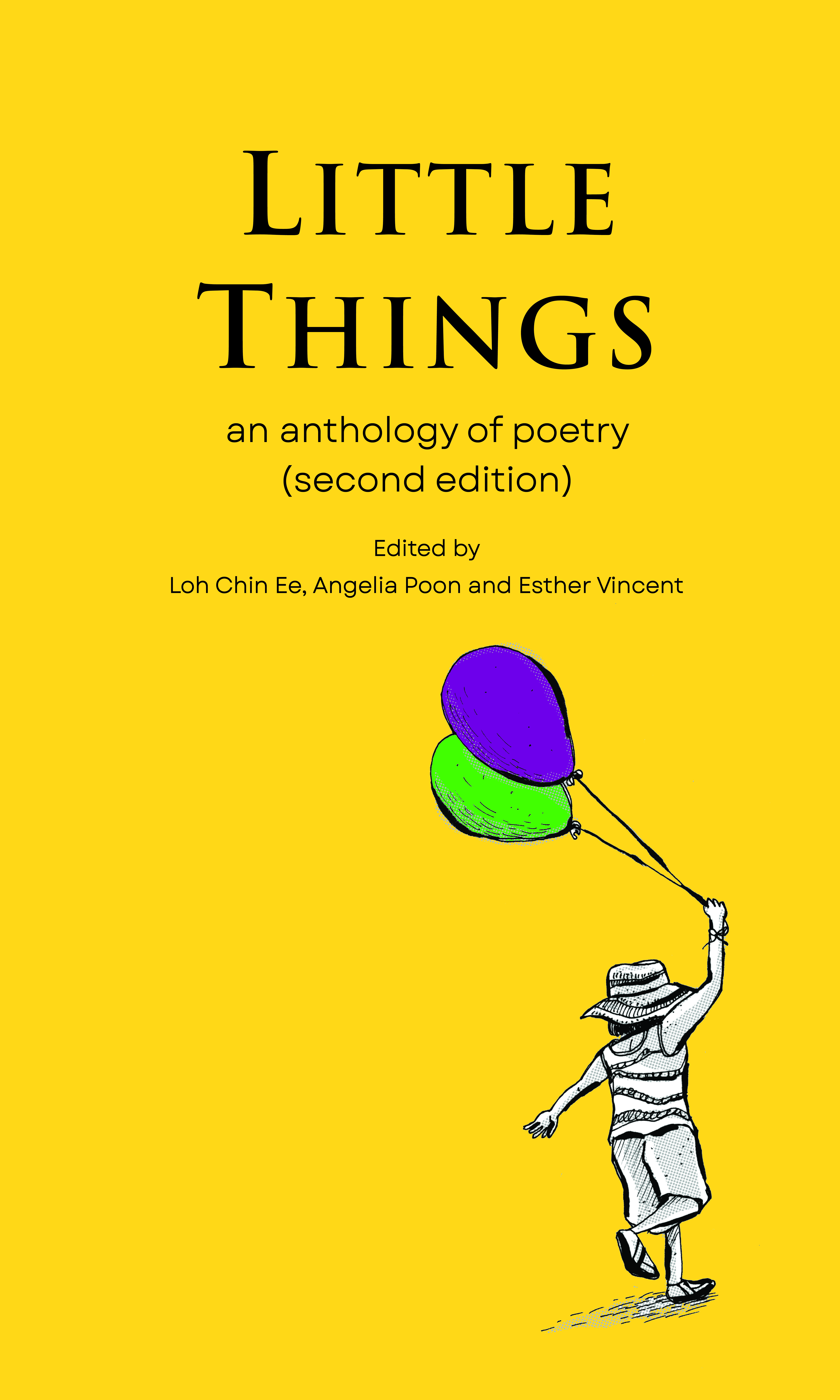
Loh CHIN EE, Angelia POON and Esther VINCENT (editors)
About the Book
Catching crickets after school, waiting for class to end, playing with lanterns during Mid-Autumn festival, watching the rain and the world go by—these are some of the little things that the poems in this anthology explore.
In this updated and expanded edition of beloved poetry anthology Little Things, poets look afresh at things mundane and universal, from birth to growing up and first love to old age and death. This second edition also adds a new section “Our Earth”, with poems that examine environmental themes. Readers will find, within a selection of around a hundred poems from Singapore and around the world, works by established and up-and-coming Singapore poets alongside well-known international poets and previously unpublished poems.
Arranged in seven broad sections—“Little Things”, “Growing Up”, “People Around Us”, “Going Places”, “Love and Loss”, “On Words” and “Our Earth”—this anthology will appeal to readers both young and old with poems that are quirky, delightful, sad, reflective and timely.
About the Editors
Loh Chin Ee is Associate Professor at the English Language and Literature Department and Associate Dean (Partnerships) at the Office of Education Research at the National Institute of Education, Nanyang Technological University. Her research focuses on young people’s reading at the intersection of globalisation and technological changes as well as the role of school libraries in fostering reading for pleasure and lifelong learning. She is the author of The Space and Practice of Reading : A Case Study of Reading and Social Class in Singapore (Routledge, 2017), co-editor of Literature Education in the Asia-Pacific (Routledge, 2018), and editor of The Reading Lives of Teens : Research and Practice. You can find out more about her research and work on her website at https://www.lohchinee.com. She enjoys the little things in life such as waking up to homemade coffee, reading a book without interruption, having time for little sewing projects and walking in the park with her family.
Angelia Poon is Associate Professor of English Literature at the National Institute of Education, Nanyang Technological University. Her research interests include postcolonial theory and contemporary Anglophone literature with a focus on Singapore and Southeast Asian writing. She is the author of Global City Dilemmas and Anglophone Singapore Literature : Intersectional Politics and Cultural Negotiations in the 21st Century (Palgrave Macmillan 2024), co-editor of Singapore Literature and Culture : Current Directions in Local and Global Contexts (Routledge, 2017) and one of the editors of Writing Singapore : An Historical Anthology of Singapore Literature in English (NUS Press, 2009). Her articles on Singapore literature and contemporary fiction have appeared in Interventions : International Journal of Postcolonial Studies, Cambridge Journal of Postcolonial Inquiry and Asian Studies Review. She also co-edited Making Kin : Ecofeminist Essays from Singapore (Ethos Books, 2021). She enjoys the little things in life like coffee in the morning and the anticipation of a good book.
Esther Vincent Xueming is the editor-in-chief and founder of The Tiger Moth Review, an ecojournal of art and literature based in Singapore. She is the author of two poetry collections, womb song (Ethos Books, 2024) and Red Earth (Blue Cactus Press, 2021), and co-editor of Here was Once the Sea : An Anthology of Southeast Asian Ecowriting (University of Hawai’i Press, 2023), Making Kin : Ecofeminist Essays from Singapore (Ethos Books, 2021) and Poetry Moves (Ethos Books, 2020). Esther has served as guest editor for Mānoa Journal (35.2), University of Hawai’i Press (2023) and as guest regional editor, Asia for a special eco-themed issue of The Global South (16.1), University of Mississippi (2022). Her essays have been published in The Trumpeter, EcoTheo Review, Sinking City Review and Quarterly Literary Review Singapore. A literature educator by profession, she is passionate about the entanglements in art, science, literature, spirituality and ecology. Besides teaching and writing, Esther is an Usui Reiki Master and ANFT Forest Therapy Guide whose practice involves relating to the more-than-human world in an embodied, heart-centred way. She enjoys the little things in life like whisking herself an oat matcha latte, being in nature and breathing in and out mindfully on and off the mat.
2025 - 172 pages - 12 X 20 cm - S$16.00 (before GST) - ISBN (paperback) : 978-981-17689-0-3 - ISBN (e-book) : 978-981-17689-1-0
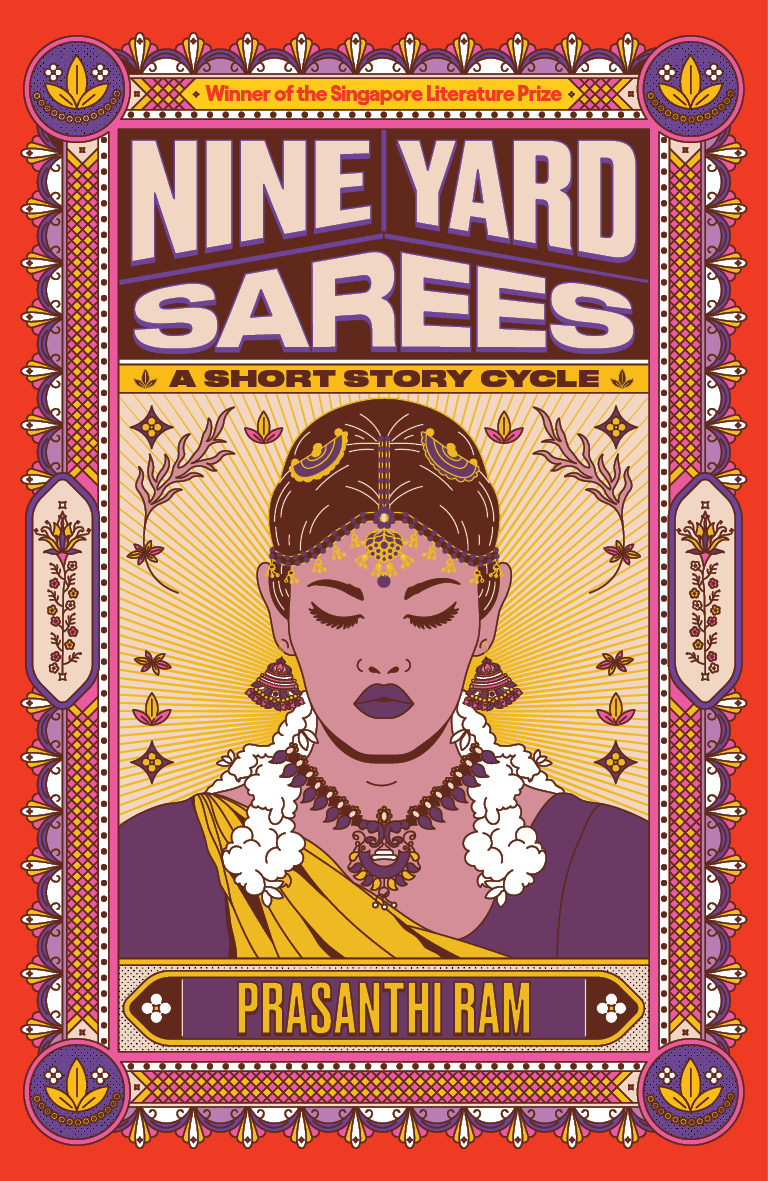
Prasanthi RAM
Nine Yard Sarees is a multigenerational portrait of a fictional Tamil Brahmin family. Comprising eleven interlinked stories, this short story cycle traces the lives of nine women from 1950 all the way to 2019, shedding light on the community and its evolution through the decades. As the stories take us from India to Singapore, Australia and even America, we follow the experiences of the women in the family : Raji the matriarch who lives in seclusion at an ashram ; her daughter Padma who struggles to raise her family the traditional way ; Padma’s daughter Keerthana who is about to be married and don the nine yard madisar, a symbol of womanhood. Tender, dynamic and full of heart, this cycle is a resonant portrayal of female solidarity and the complexities of the diasporic experience in contemporary Singapore.
About the Author
Prasanthi Ram (Dr) is a full-time writing lecturer at Nanyang Technological University, where she completed her PhD in creative writing. Born out of her dissertation, Nine Yard Sarees is her debut work of fiction. Other short stories can be found in a variety of publications including Best New Singaporean Short Stories : Volume Five (Epigram Books : 2021) and Food Republic : A Singapore Literary Banquet (Landmark Books : 2020). She also writes personal essays that have been published in What We Inherit : Growing Up Indian (AWARE : 2022) as well as Making Kin : Ecofeminist Essays from Singapore (Ethos Books : 2021). In 2020, she co-founded Mahogany Journal, an online literary journal that platforms South Asian writers in Singapore, and currently serves as its fiction editor. As a Tamil Singaporean herself, Prasanthi hopes to write more fiction that places her community on the literary map. She also hopes to raise a dog and live near the coast someday.
Praise
“There is so much to appreciate in Prasanthi Ram’s debut collection, Nine Yard Sarees. As a portrait of a family, these stories connect to form a layered narrative about women, migration and identity. As a work of diaspora fiction about the Tamil-Brahmin community in Singapore, these connecting stories comment on questions of belonging and the pertinent tension between tradition and modernity. Ram writes with precision and clarity about this family while also treating the characters with the warmth and compassion that they deserve. Shifting narrative perspectives and covering a wide landscape of time and geographic space, Nine Yard Sarees confronts diaspora in all its complexity. A thoroughly enjoyable and meaningful work of fiction about family, community and the reverberations of migration and displacement.”
—Balli Kaur Jaswal
Author of Erotic Stories for Punjabi Widows
« A gripping, masterfully crafted work that is both haunting and comforting. I read it in one night. »
— Akshita Nanda
Co-winner of the 2020 Singapore Literature Prize in English Fiction
“Populated by a rich cast of characters you immediately fall in love with, these linked stories are bursting at the seams with tenderness and heart.”
— Cheryl Julia Lee
Author of We Were Always Eating Expired Things
Asst. Professor of English, Nanyang Technological University
“In Nine Yards Sarees, you are welcomed into the intimate universe of an Iyer family in Singapore and to life in Singapore—a narrative that is so vivid, that you would feel you are breaking bread with them at the dining table. The stories are interwoven and yet stand-alone whilst navigating tradition and modernity, acting as a mirror to every migrant’s soul.”
— Dr Anitha Devi Pillai
Author, Academic and Translator
“The madisar, the eponymous nine-yard saree, weaves these stories together beautifully and artfully, these stories about Tamil Brahmin women living mostly in Singapore, but also living, in Prasanthi Ram’s deft, sensitive and humorous telling, in full, human complexity in their loves and hates, joys and sorrows, envies and regrets. Nine Yard Sarees is an uncommonly rich and precise debut, closely observed, magically empathetic and formally ambitious. If you love the stories of Jhumpa Lahiri and Alice Munro, you will love these stories.”
— Jee Leong Koh
Winner of the 2022 Singapore Literature Prize in English fiction
“Nine Yard Sarees is a family portrait that tells the story of the Srinivasans, a family from Kalakad, India, who immigrate to Singapore in search of a better life. The book follows their lives over the course of several decades, as they navigate the challenges of adjusting to new lands, identities and cultures while trying to maintain traditions. The stories unfold through the perspectives of nine women who recount tales of their parents, grandparents, siblings and loved ones. Comprising eleven interlinked stories, this well-written book offers a unique perspective on the immigrant experience. Nine Yard Sarees expresses the power of family, the fortitude of women, and the resilience of the human spirit.”
— Latha
Author of The Goddess in the Living Room
2023 - 272 pages - 13 X 20 cm - SGD$22 (before GST) - ISBN (paperback) : 978-981-18-6035-5 - ISBN (e-book) : 978-981-18-6036-2
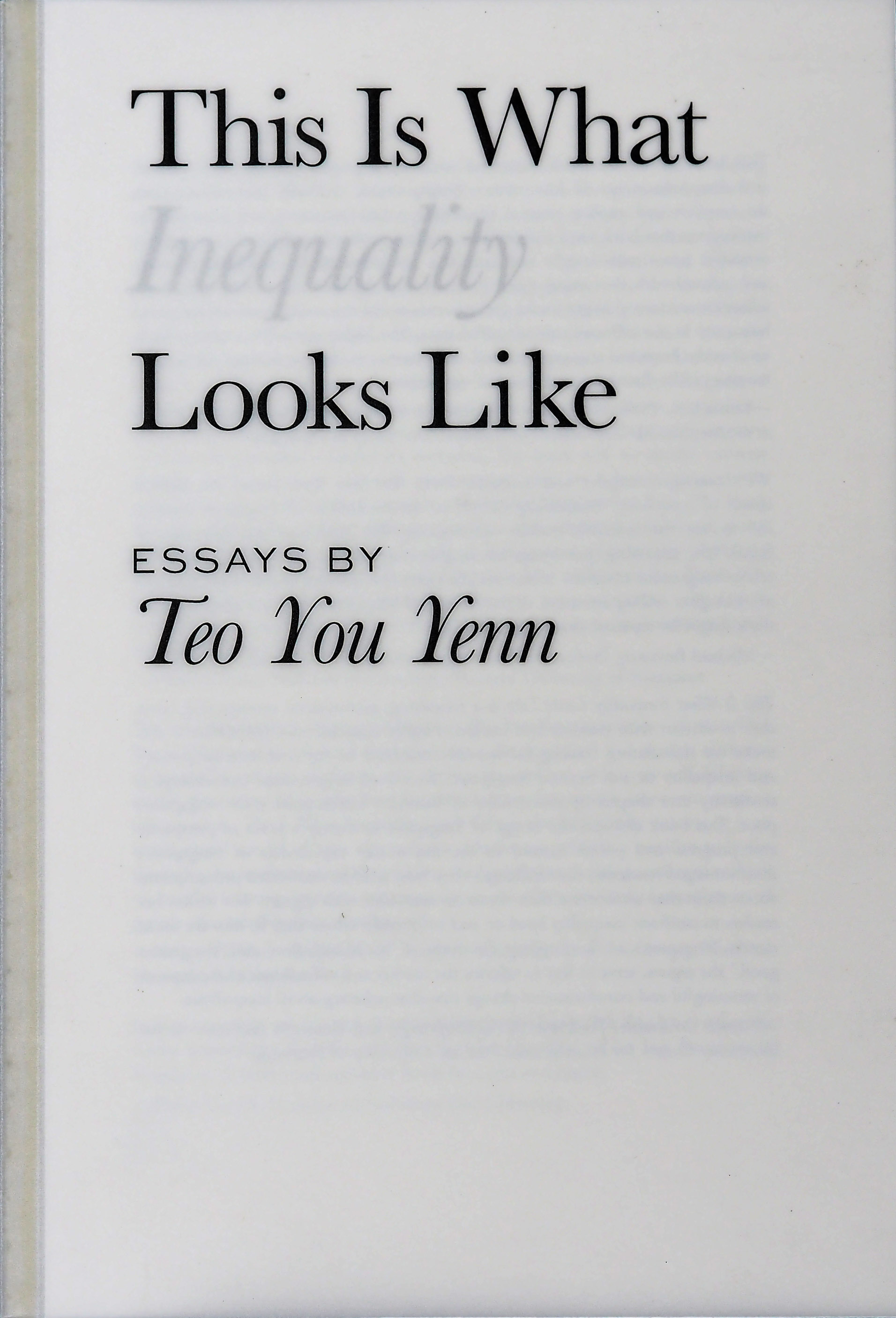
Teo You YENN
The New Edition of This Is What Inequality Looks Like by Teo You Yenn features a new Afterword by the author, and a Foreword by Kwok Kian Woon, Professor of Sociology at the Nanyang Technological University, Singapore.
About the Book
What is poverty ? What is inequality ? How are they connected ? How are they reproduced ? How might they be overcome ? Why should we try ?
The way we frame our questions shapes the way we see solutions. This book does what appears to be a no-brainer task, but one that is missing and important : it asks readers to pose questions in different ways, to shift the vantage point from which they view ‘common sense,’ and in so doing, to see themselves as part of problems and potential solutions. This is a book about how seeing poverty entails confronting inequality. It is about how acknowledging poverty and inequality leads to uncomfortable revelations about our society and ourselves. And it is about how once we see, we cannot, must not, unsee.
About the Author
TEO You Yenn received her PhD in Sociology from the University of California at Berkeley. She is Associate Professor and Provost’s Chair in Sociology at Nanyang Technological University. Her work has been published in journals such as Economy and Society, Signs, Social Politics, and Development and Change. She is the author of Neoliberal Morality in Singapore : How family policies make state and society (Routledge, 2011). She is recipient of NTU’s Nanyang Education Award (2013) and the American Sociological Association Sex and Gender Section’s Feminist Scholar Activist Award (2016). In 2018, for her contribution to igniting a national conversation on poverty and inequality with the book This is What Inequality Looks Like (2018), she was named a Finalist in the Straits Times Singaporean of the Year Award.
Praise
An exceptionally high rating on Goodreads by readers of the book.
This book is a remarkable rarity—a vivid ethnography of the lives, dreams and disappointments of low-income Singaporeans, skillfully intertwined with the implicit and explicit mental ideologies, social structures and bureaucratic institutions that both bind and separate us from each other. Delivered in slender, evocative prose with insight and empathy, yet informed by analytical distance and infused with theoretical rigor, it shows that the lives of our often-forgotten fellow citizens reveal larger truths about ourselves and our society, and the nature of humanity in our affluent post-industrial state. The highly accessible narrative both touches the heart and engages the mind, and deserves to become the basis for a wide-ranging public discourse on the soul of our nation.
— Linda Lim, Professor Emerita of Corporate Strategy and International Business at the Stephen M. Ross School of Business, University of Michigan
With courage, integrity and scientific tools, Teo You Yenn enters the hidden abode of inequality. Immersing herself in the underside of Singapore society, she makes the invisible visible – contrasting the hardships and precarity of family life, schooling, parenting, housing among low income residents with the taken-for-granted comforts of the middle class. She disrupts widely-held national mythologies, calling attention to the defects of Singapore’s welfare state and how these might be repaired. Sociology at its best !
— Michael Burawoy, Professor of Sociology, University of California, Berkeley
This is what inequality looks like is a masterfully crafted text. Consciously avoiding academic frames, Teo You Yenn’s ethically and politically grounded narrative unfolds through vignettes of lived experiences that stand in sharp, stark contrast to the dominant imaginings of Singaporeans as mobile, cosmopolitan, free, agentic, affluent global citizens. Drawing on everyday lives of individuals and families, privileging their voices through the choice of ethnography—the book’s ten chapters communicate the pathos and experiences of being poor and living under conditions of inequality in a cosmopolitan city-state. The book’s lens is focused critically on popular, academic and state discourses about Singapore society. The book is a much needed intervention in hitherto un-problematised, taken-for-granted conclusions about poverty (its absence and then its causes), about inequalities, about responsibilities of the state and social structures in Singapore—regnant amongst Singaporeans—academics included. The book will no doubt resonate globally and has obvious analytical reverberations that are delivered through the empirical richness of a veiled segment of everyday Singaporean lives. The book disturbs deliberately, asking difficult questions that demand considered moral responses, highlighting above all the role of institutional structures in producing the context for the unfolding of experiences of poverty and inequality. Teo’s voice, heard powerfully and honestly throughout the text, is a provocation ; each page is etched with an inspiration and moral compulsion to engage—an invitation that is impossible to resist.
— Vineeta Sinha, Professor of Sociology, National University of Singapore
This is What Inequality Looks Like is a refreshing, provocative, eye-opening book that is written with passion and insight. Highly readable and accessible, it will make for stimulating reading for anyone interested in the problems of poverty and inequality in and beyond Singapore. Teo’s work is grounded in sociological sensitivity and shaped by three years of intimate interactions with Singapore’s poor. This book disrupts the image of Singapore as merely a place of prosperity and progress and points instead to the day-to-day experiences of Singapore’s disadvantaged residents, the challenges they face, and the embedded presumptions about them that undermine their access to assistance with dignity. Teo invites her readers to confront inequality head on and to consider where they fit into the social matrix. Singapore’s overly-simplistic discourses of “social inclusion” and “the greater good,” she argues, serve in fact to valorize the market and self-reliance at the expense of meaningful and transformative change aimed at reducing social inequalities.
— Nicole Constable, Professor of Anthropology and Research Professor in the University Center for International Studies, University of Pittsburgh
This is a remarkable book in so many ways. Teo You Yenn encourages all of us who live in Singapore to ask hard questions about the structural and psychic elements of inequality, and to challenge the comforting and yet ultimately self-defeating stories that many of us who have benefitted from Singapore’s economic progress tell ourselves. This is What Inequality Looks Like is also beautifully written. It is an inspirational model of how an academic scholar can address a popular audience through a deep reflection on her position as a Sociologist, inviting readers to embark on parallel learning journeys commencing in the often overlooked experiences of people who inhabit other social worlds.
— Philip Holden, Professor of English Language and Literature, National University of Singapore
In this accessibly written and closely observed new book, Teo You Yenn takes the reader beyond the statistics and into the everyday lives of the less fortunate in Singapore. A timely and necessary book for a city in a hurry.
— Philip Gorski, Professor of Sociology, Yale University
2019 - 312 pages - 15 X 22 cm - S$26.00 (before GST) - ISBN (paperback) : 978-981-14-0595-2
Contact : NG Kah Gay